
- Your cart is empty
- Continue shopping
Shop


EMBRACING BOTH INCLUSIVE DEMOCRACY SERVICE DELIVERY


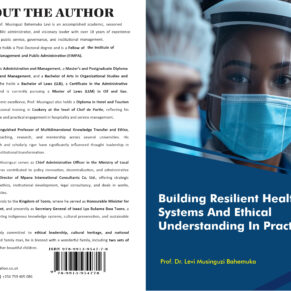
Considering the notation of how the public sector, for example the district level local government makes sense of Performance Management and Evaluation System (PMES) aiming at driving forward the improvement in public service and enhancing the sustainability of service quality, this study explores the implications of the PMES implementation after the major civil service reform in 2000. And although there is rich literature on performance management, there is limited in Uganda’s context, particularly at the District level, the District CAOs scheme as well as the incentive schemes put force to motivate and enhance such development and improvement. The empirical study relies on a qualitative approach through intensively exploring a District case study. In-depth, semi- structure interviews have been conducted within the District, as well as with executives from central agencies, training and development institutes, and key resource persons who are directly involved in the PMES implementation. The data analysis reveals that a strong commitment of the government at policy level brought in support and coordination among central agencies and has altered attention and resources towards the system implementation. Additionally, the PMES implementation together with the promotion of the District CAO scheme has created new challenges for the District Governors and the District administration in which there is shown to be a shift from an administrative approach to a more managerial and participative one. The performance agreement (PA) has played a crucial role in improving and evaluating performance, driving public sector development, and linking performance with the monetary incentive schemes. However, the study also finds a limitation of the PA execution in relation to its linkages with incentive distribution to individuals. Furthermore, several incentive schemes are available for different groups of people and cause misunderstanding and demotivating affects which, in turn, has impacts on the PMES as a whole. The findings of this research provide new evidence on the PMES implications at the District level in the Uganda public sector in which political policies are cascaded down into real Practices and execution. Therefore, the result could be considered as extending the knowledge boundary in the context of public Administration management. Critically, the research highlights significant implications and specified factors enabling and inhibiting success in the PMES implementation in organizations.





Customer reviews
Reviews
There are no reviews yet.
Write a customer review